
Ah, Lexus, the epitome of Japanese hospitality, craftsmanship, luxury and technology. As the luxury arm of Toyota, there’s always something magical about a Lexus vehicle that blends Toyota’s engineering and reliability with a luxurious and upmarket positioning. And what better way to experience that with the NX 450h+ F SPORT.
To be honest, Lexus’ naming conventions isn’t the easiest to follow. Before you get confused why “NX 450h+ F SPORT” is such a big deal, here’s a quick crash course on what all those random strings of letters above meant.
NX – Nimble Crossover. This is Lexus’ compact crossover, meant to be nimble and easy to drive around in city. In Singapore, this is the second largest sports utility vehicle (SUV) available, sitting below the mid-sized RX and above the LBX and UX. The NX is also one of the brands bestselling nameplates globally. Today, the NX is in its second generation.
450 – This denotes the engine power. In the past, this number represents the engine displacement. E.g. 200 refers to a 2-litre engine, but nowadays, this number is arbitrary and simply represents the aggregate engine power along its lineup. 450 is quite a big number and in this case, the NX 450h+ produces 304 bhp, 0–100 km/h in 6.3s, no slouch. The 450 is also the most powerful version of the NX.
h+ – The single letter ‘h’ denotes that this is a hybrid vehicle, and the + indicates that this is a plug-in hybrid, different from Lexus’ usual offerings which are self-charging hybrids. The NX 450h+ is Lexus’ first ever plug-in hybrid vehicle.
F SPORT – This denotes the equipment trim level. Technically, this is Lexus’ highest trim level (most expensive) available, above executive and luxury, and should with all available equipment upgrades, sporty bits and bops on the car exterior. Sounds logical enough, until you realise the so-called top-dog F SPORT trim doesn’t even come with Mark Levinson speakers (a Lexus staple), 360-degree camera, or auto-parking — all of which you can get in the Luxury trim of the NX.

Photo © Calixto Tay
To sum it all up, the NX 450h+ F SPORT is Lexus’ best selling nameplate, in the most powerful engine variant, which Lexus’ latest plug-in hybrid technologies, and in the most sporty trim that is available.
In our tests, we were genuinely blown away. This is, without exaggeration, one of the best vehicles we’ve ever driven. And for those who can afford it (S$459,800 as of October 2025, cough), it’s definitely one worth serious consideration.
The Highlights of a Perfect Car
To me, perfection in a car does not come in from a singular element. Having the best internal materials, best cabin space, engine specs, etc alone does not make for a perfect vehicle. The car has to excel in almost every area, from visual appeal, drive, practicality and comfort. It also has to be good in user experience, making day-to-day usage of the car convenient, intuition, presents as little friction and annoyance as possible. The car has to let the driver do what he wants without getting in the way, while still ensuring the driver is safe and excited.
And in our tests, the NX 450h+ F SPORT came really close to perfection.
The Pursuit for Perfection You Can’t See
These days, many car brands pour their energy into creating a strong first impression. When designing new models, much of the resource and budget often goes into the interior design, the materials, and the showroom wow-factor features, rather than the fundamentals of what makes a car truly great: how it drives.
Cars need to shine under bright showroom lights, where decisions are often made based on what looks and feels premium. But, most buyers can’t really tell whether a car drives well or not from a short, few-minute test drive.
Therefore, it is refreshing to me that Lexus poured into improving the drive of the current (second generation) NX. The pursuit for perfection in things that people can’t see.
A brief history of second generation NX’s development
Have you ever been to a test track with a totalled car displayed in the lobby? “Test Course No. 3” part of the Shimonyama Technical Centre features exactly that.
This track embodies the Lexus philosophy that “roads build the car.” It’s packed with blind corners, jump spots, off-camber bends, nasty high-speed elevation changes, and even potholes and uneven surfaces.
And that totalled car in the lobby? It was a GR Yaris crashed by Morizo — also known as Lexus Master Driver, Chairman of Toyota, and yes, Akio Toyoda himself. That totalled car is a badge of honour that even the most skilled driver isn’t immune to the track’s brutal challenges.
Why mention this track? Because the second-generation NX, the one we’re reviewing today, was the first Lexus vehicle developed and tested there. This shows the amount of testing and development that goes into the second-generation NX, and again, these are things that you can’t see by just sitting in the car at the showroom.
On top of that, the brilliance of Shimoyama doesn’t just lie in the test course. It lies in its true spirit of genba (meaning ‘where the work happens’ in Japanese). Test drivers can run a few laps, note exactly how the car behaves (and misbehaves), then roll straight back into the on-site garage where engineers are waiting. Immediate feedback, instant tweaks, constant and rapid improvements, that is what makes a car reliable, durable and fantastic to drive.

The Lexus Signature hindquarters. Photo © Calixto Tay
Lexus Driving Signature
The whole she-bang about NX’s development history leads to this: Lexus Driving Signature. This is a name given to Lexus’ first real and serious attempt to define a “Lexus driving feel” and incorporate that into all their vehicles. The second-generation NX is the first to receive it.
In engineering speak, this translates into developing a chassis and suspension package built to handle punishment and yet handles like a champ. It rides on a MacPherson strut front and double-wishbone rear, with specially-developed shock absorbers tuned to optimise damping at low speeds. Add in Lexus’s first-ever variable-ratio steering rack, which sharpens manoeuvrability at low speeds while improving stability at higher ones, and you get an SUV that feels confident whether you’re crawling through carparks or blasting down expressways.
Thoughtful, Luxurious and Practical Interiors
All that focus on what you can’t see doesn’t mean Lexus has neglected what you can see.
Step inside the Lexus NX and it’s clear: this is one of the most refined, well-thought-out interiors you’ll find in any car at this price point. Lexus has always prided itself on craftsmanship, but the NX feels like a masterclass in how to be restrained, luxurious, and practical all at once. A 360-degree viewer is attached so you can pan, zoom and pinch to your heart’s content.
Tazuna Design Concept
At the heart of it is Lexus’ “Tazuna” cockpit design concept (‘tazuna’ literally means ‘horse reins’ in Japanese). The idea is simple: everything you need is within easy reach of your arm, so you never have to take your eyes off the road. Even the far edges of the large infotainment screen are comfortably accessible without you having to stretch or contort your body to reach it.
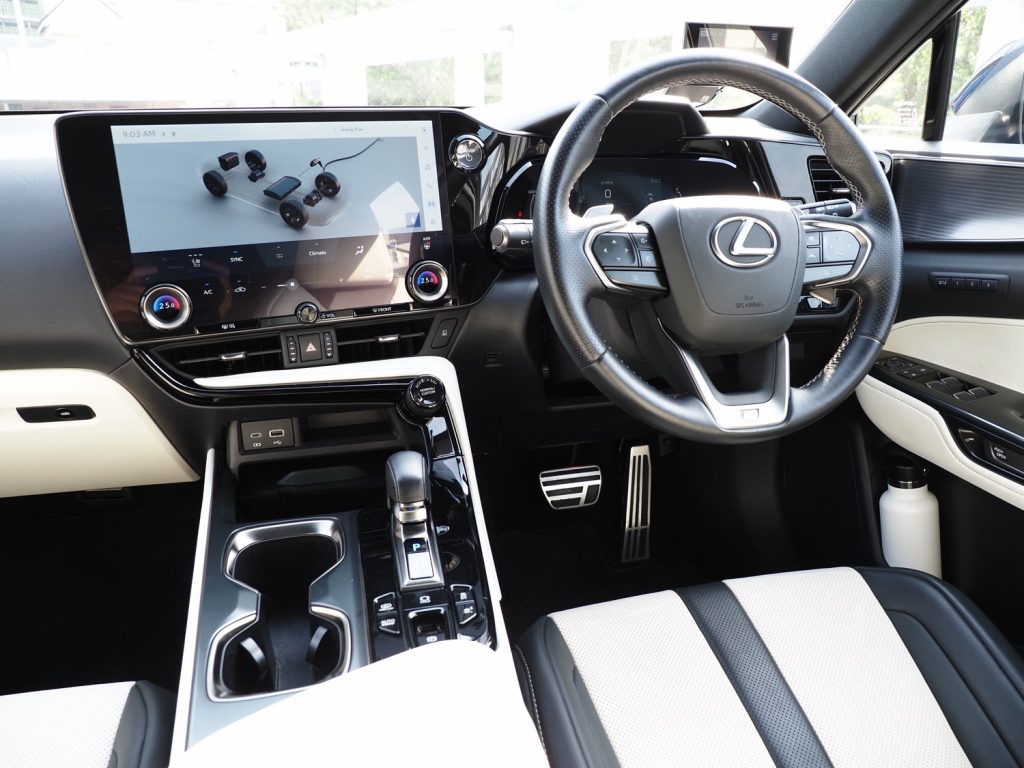
Everything is angled towards the driver. And everything is reachable without taking your eyes off the road or yoga stretches. Photo © Calixto Tay
The fighterjet-like instrument cluster is another highlight. It’s razor-sharp, extremely high-definition, and remains perfectly visible in all conditions. More importantly, it’s laid out in a way to give you all the information you need.
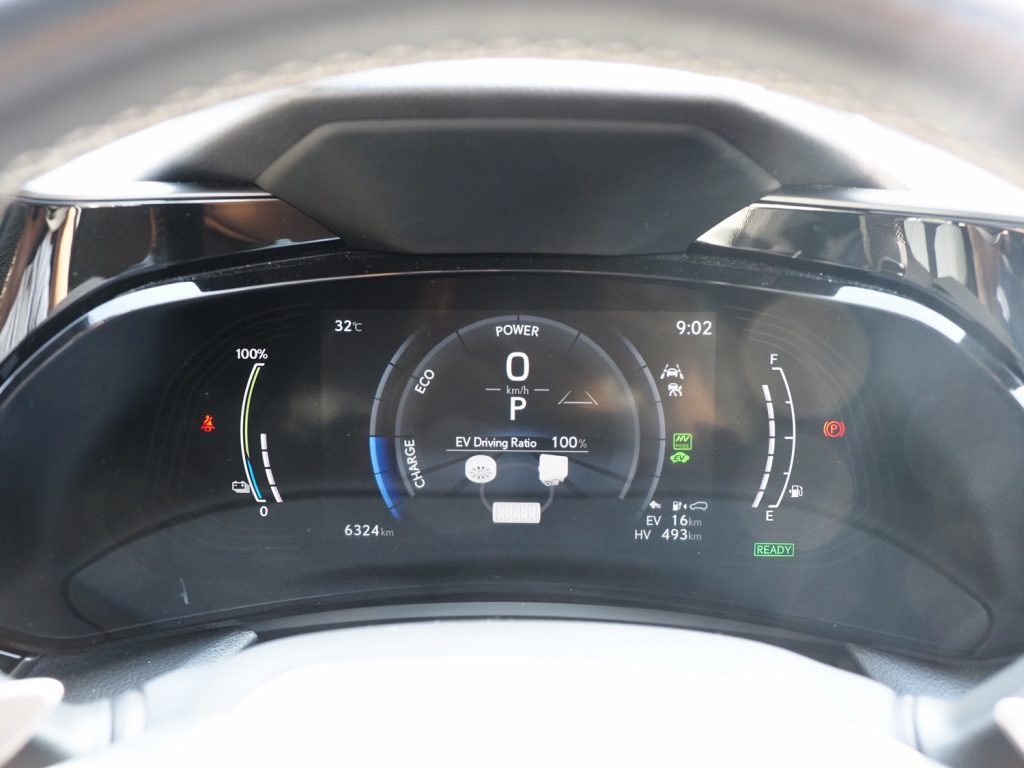
High definition instrument cluster. Battery level on the left, fuel gauge on the right. All kinds of customisable display in the middle. Photo © Calixto Tay
Nothing hidden
While many modern cars love to bury controls in endless menus, the NX takes the opposite approach. Everything is logical, intuitive and easy to access, meaning less distraction when driving. This includes things such as climate control where Lexus has removed most of the physical buttons, the two most important controls – temperature – still exists as physical dials and the rest of the controls live on the touch screen at all times.
Intelligent Door
The NX is the first Lexus with electronic door latches, and of course, there’s a deeper reason for it beyond gimmicks. This is actually a safety feature, detecting pedestrians, cyclists, or passing cars before letting you open the door — smart, and potentially life-saving.
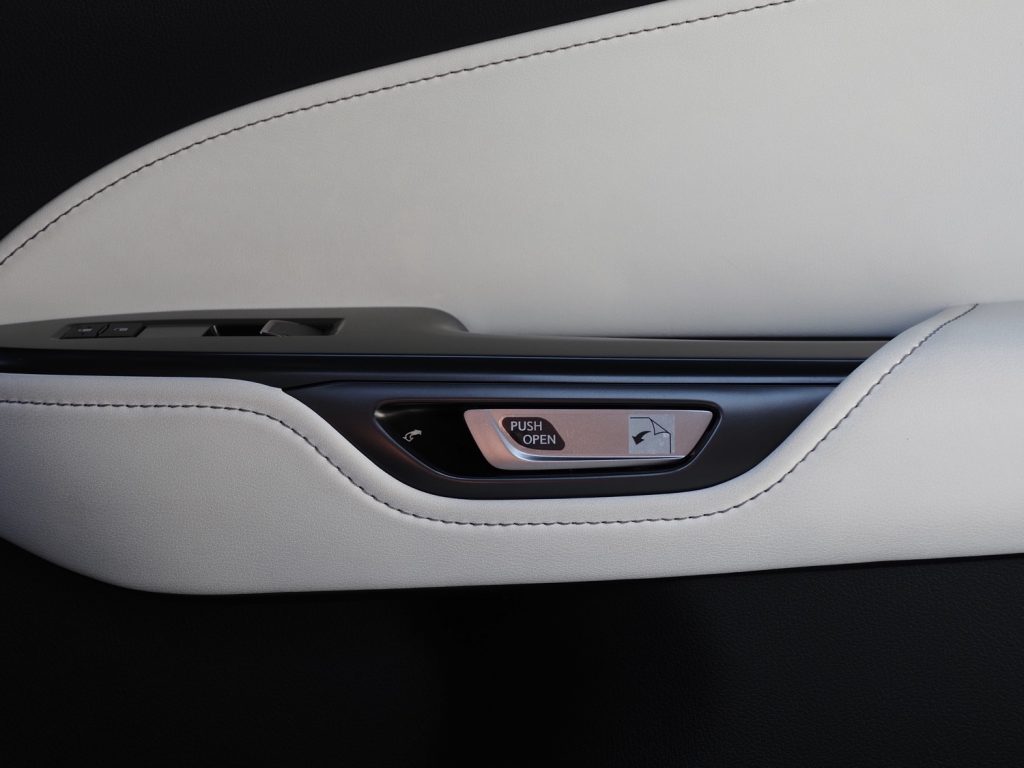
Press to open the door. Or pull twice if everything has failed. © Calixto Tay
And if you are often worried about electric failure and getting trapped in a car with electronic latches, know that on the Lexus, mechanical fallback is easy and readily availability. In case of failure, simply pull the latch twice instead of of the usual single press for a mechanical fallback. Intuitive, safe, and very Lexus.
Insanely Good Storage
Then there’s the storage. Lexus has clearly spent a lot of time thinking about how people actually live with their cars. The cup holders, for example, are massive. I’ve tested plenty of cars, and my large thermos bottle refuses to fit in 99.999999% of them. The NX? No problem at all — it slots in comfortably, like it was designed for it.
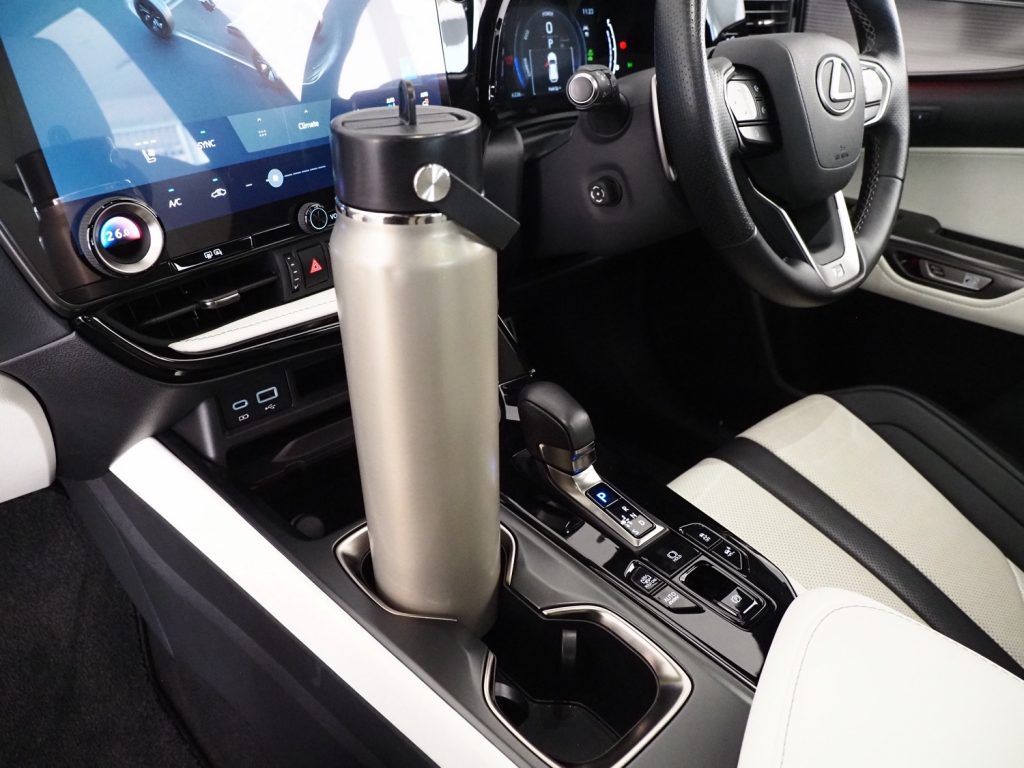
The Lexus NX is the only car I’ve tested that can hold my gigantic thermal bottle. Photo © Calixto Tay
There’s also a dedicated phone storage compartment that keeps your device out of sight (and temptation) while charging. And if you ever have to slam on the brakes, your phone won’t go flying across the cabin. Prefer a wired connection? There’s a large open storage area with easy access to charging ports.
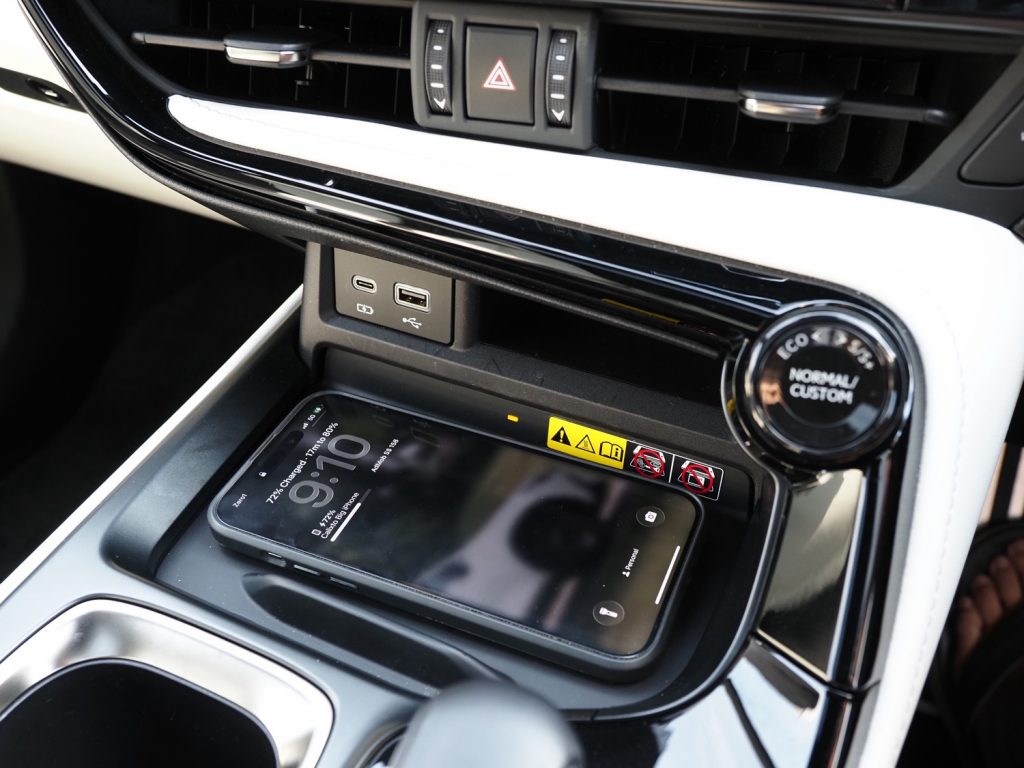
Slide in that tray and your phone is out of sight and out of mind, while still charging. Photo © Calixto Tay
The centre console box is another clever touch: it opens from both sides, so both driver and passenger can get to it without awkward contortions.
-

- Open from the driver’s seat. Photo © Calixto Tay
-

- Open from the passenger’s seat. Photo © Calixto Tay
Add to that a huge glovebox, a smaller driver-side cubby for cards or toll cash, sunglasses storage, and even card slots built into the sun visors, and you start to wonder if Lexus’ engineers moonlight as IKEA designers.
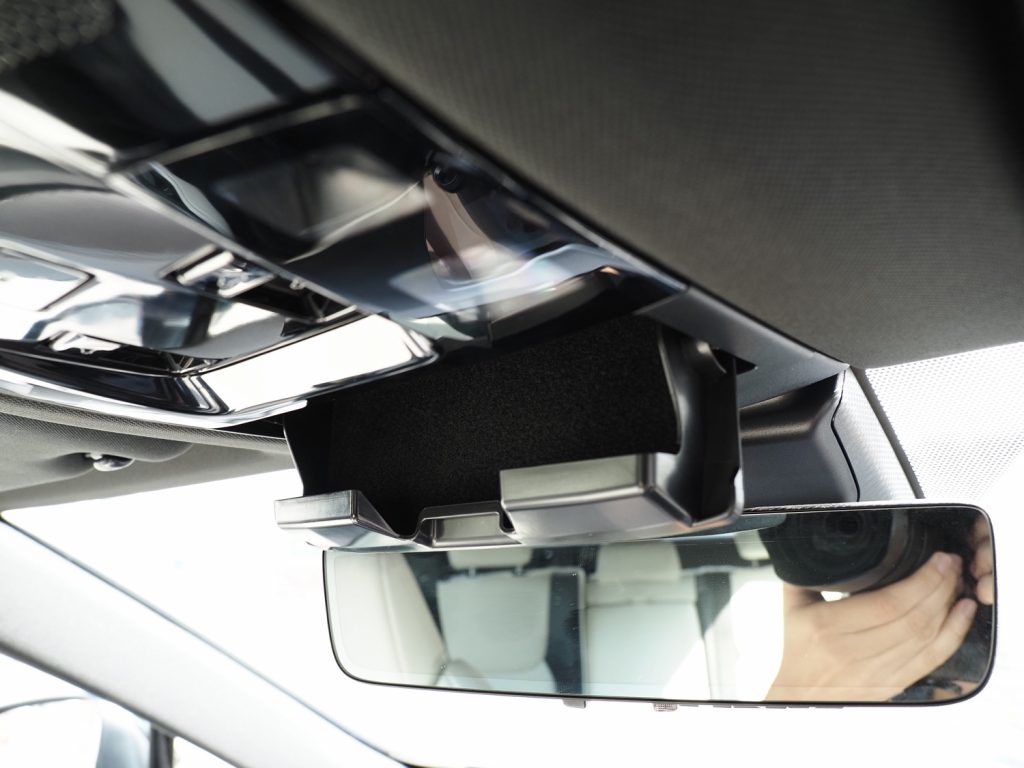
Glasses compartment! An increasingly rare sight. Photo © Calixto Tay
Space is also generous. While not as spacious as competitors such as the Mercedes Benz GLC or BMW X3, It never feels cramped in the NX, whether it’s the legroom, headroom, or knee space.
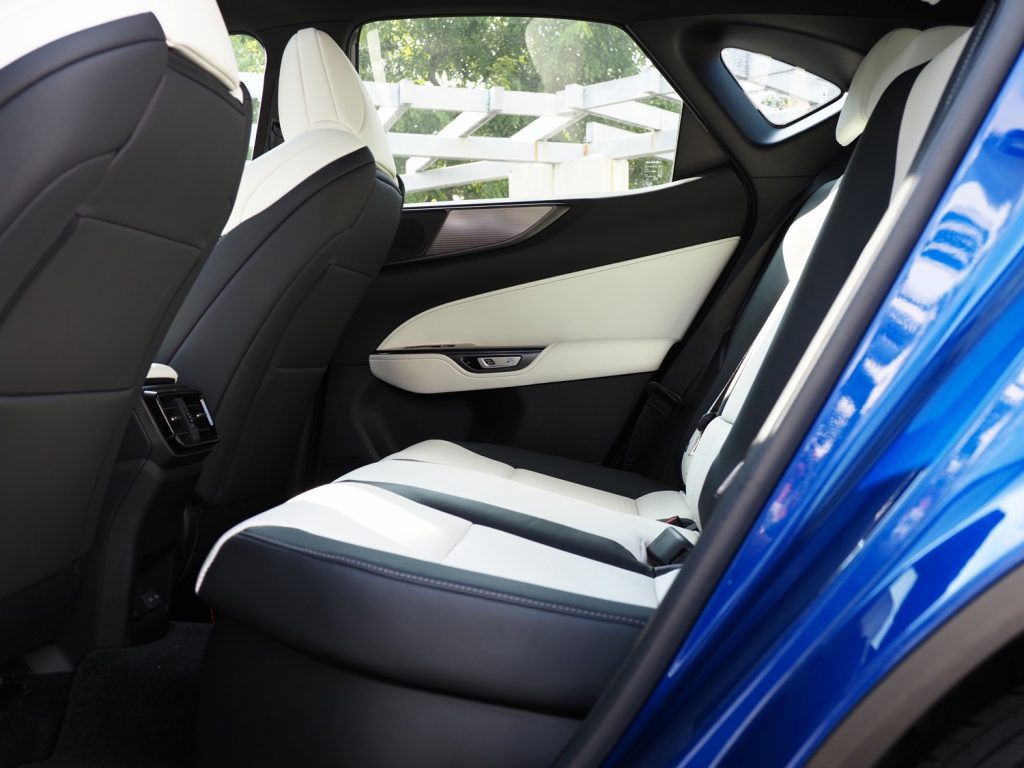
Photo © Calixto Tay
The 520L boot is equally generous, with extra deep, secretive underfloor storage for good measure.
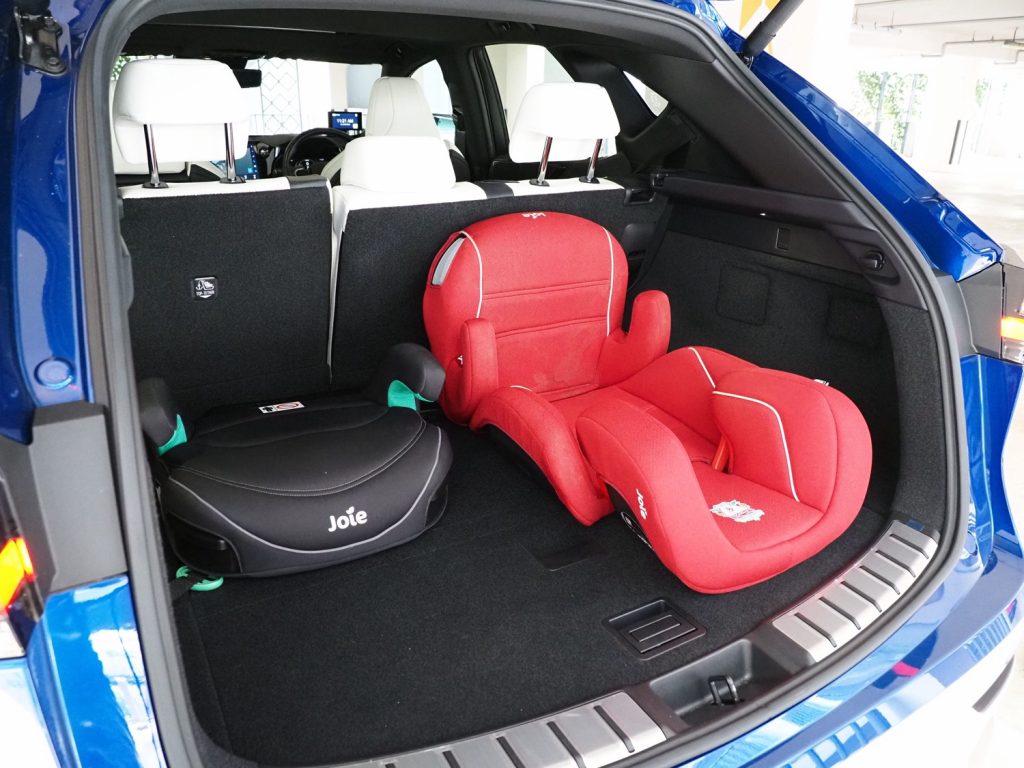
520L boot space. Deliciously sizeable. Photo © Calixto Tay
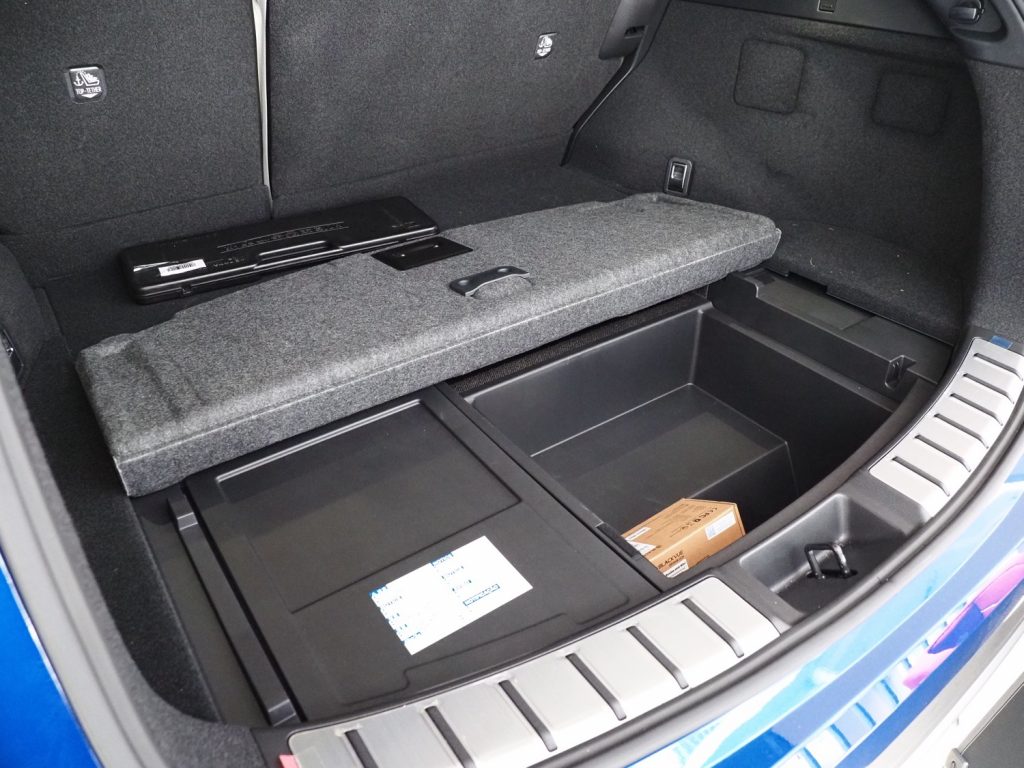
Fold up the boot floor and you get even more space. The 12V battery is housed in the left half. Photo © Calixto Tay
What’s worth noting here is that despite also carrying a 18.1 kWh battery compared to the 1.0 kWh battery of its self-charging brother, the NX 350h, the Lexus NX 450h+ F SPORT has the exact same fuel tank size, cabin space and boot space as its brother.
The 450h+ Drivetrain
Now, let’s take a deeper look at the very interesting 450h+ drivetrain. Under the bonnet, we get a 182 bhp 2.5-litre inline-4 petrol engine paired with a front 180 bhp and rear 54 bhp electric motor, creating an all-wheel-drive setup. While this is the same setup as the NX 450h+’s little twin brother, the NX 350h self-charging hybrid, the 450h+ crucially differs by sporting an 18 times larger battery — 18.1 kWh lithium-ion pack instead of the 1.0 kWh unit in the 350h.
The much larger battery enables a longer EV-only range, and allows for more power output allowing the 450h+ to deliver 304 bhp with a 0-100 km/h time of 6.3s, making this one of the fastest Lexus you can currently buy in Singapore. This is contrasted with the 240 bhp of the 350h that makes 0-100 km/h in 7.7s.
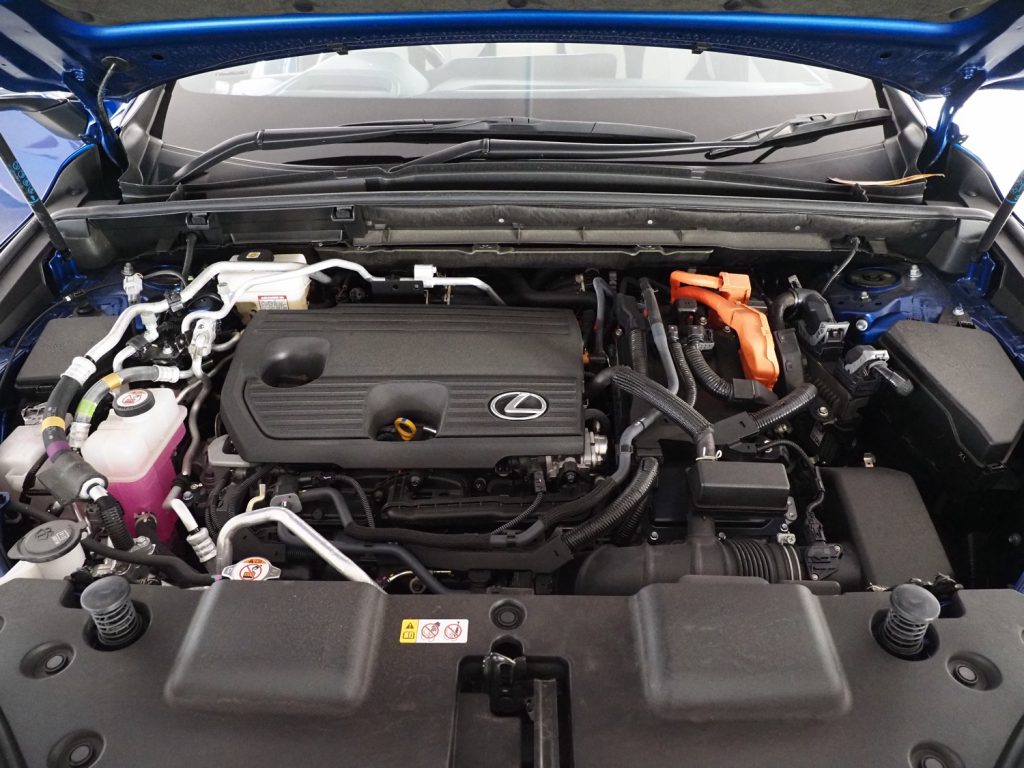
2 EV motors and a large 2.5 litre engine all live under the same hood. Photo © Calixto Tay
While you can charge the NX 450h+ via AC charging at 6.6 kW, there’s one critical area in which the 450h+ differs from PHEV by other manufacturers — you don’t really have to plug it in.
This is to a large extent thanks to the fact that the 450h+ is built upon the self-charging hybrid technology of the 350h.
Driving Modes: Three Personalities in One
By driving modes, we’re not talking about the usual Eco, Comfort, Sport, and Sport+ toggles. On top of those usual toggles, the 450h+ also gives you additional options: EV Mode, Hybrid Vehicle (HV) Mode, and Auto EV/HV Mode (which is closer to how other PHEV functions).
Think of it as having an EV, a self-charging hybrid, and a PHEV all in one.
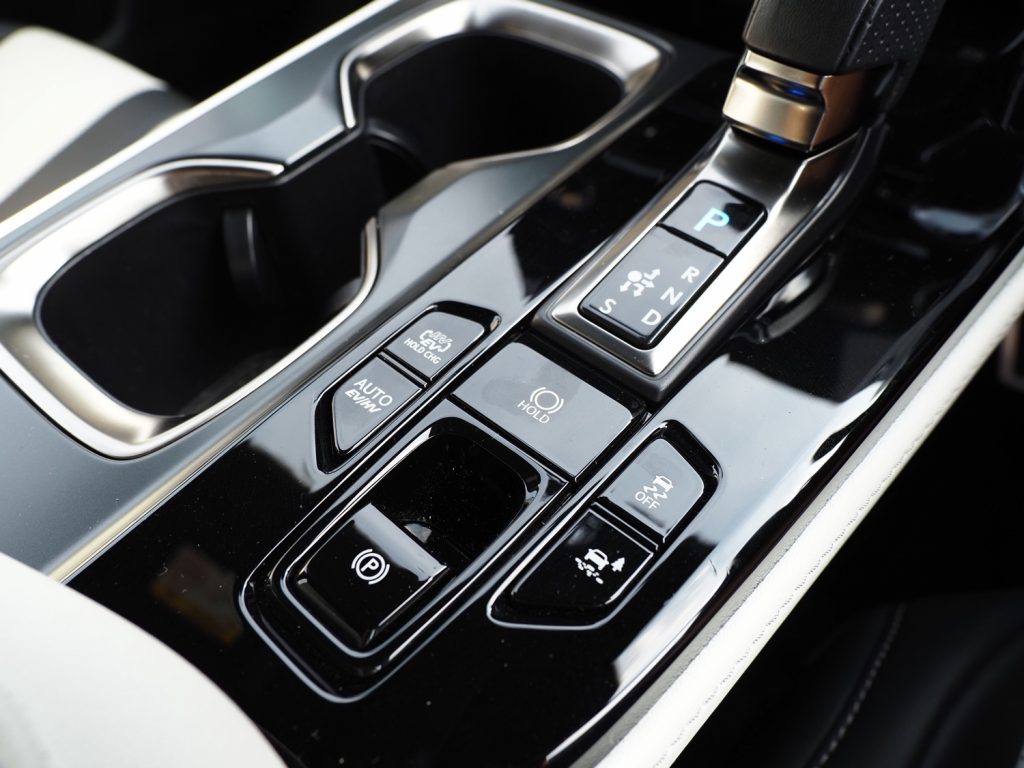
Note the selectors on the left. Photo © Calixto Tay
EV Mode
This is the car’s zen monk setting. If you charge it nightly, you can glide around town almost guilt-free, burning no fuel and emitting nothing but smug satisfaction. The trade-off is performance: you’re limited to 180 bhp from the front motor and 54 bhp from the rear motor, so you won’t get the full 304 bhp that Lexus has hidden under the hood. Also, 18.1 kWh isn’t much by EV standard (most EVs are 60 kWh and up), so expect the pure EV range to be less than 100 km.
Hybrid Vehicle (HV) Mode / “Hold Charge”
Switch to HV mode and the NX becomes your thrifty uncle. It behaves almost exactly like the 350h self-charging hybrid, but with an 18-times larger battery, meaning better efficiency and way more storage for regenerated electricity. You still get the full performance of both engine and motors, and in theory, you could run it like this forever without ever plugging it in. Even on a flat battery, HV mode works because the self-charging mechanisms would charge up the battery in no time as you drive.
That said, we noticed a quirk. “Hold Charge” doesn’t quite mean what it says on the tin. In our testing, the battery range dropped by about 1 km every time we restarted the car, even when we weren’t using the EV mode. Not a deal-breaker, but it means your battery reserve will slowly drain over time.
Auto EV/HV Mode
And then there’s the track-day hooligan mode — or more accurately, the “best of both worlds” setting. Charge regularly, keep fuel in the tank, and the car will shuffle seamlessly between EV silence and combined power. Around town, it’s deadly quiet. Plant your foot, and suddenly both petrol and electric join forces for full-bore acceleration. It’s addictive.
Together, these modes make the NX 450h+ incredibly flexible. It can be a daily EV with petrol backup, a super-efficient self-charging hybrid with a monster battery, or an all-out performance SUV tapping into the combined drivetrain. Few cars give you this much freedom in how you want to drive — it’s like having three cars in one.
Here’s a driving POV video of our tests, where we switch the NX 450h+ between the different drive modes. Put on your earphones and listen closely to the cabin — you’ll notice the subtle (and not-so-subtle) aural differences between modes. And if you’re curious about how power is being juggled between the wheels, petrol engine, and electric motors, keep an eye on the infotainment display — energy flows are illustrated on the diagram, another hallmark of Lexus/Toyota hybrid vehicles.
Which to choose? NX 350h or 450h+?
On paper, the NX 350h and NX 450h+ look almost like twins. All the advantages and perfectionist touches of the second-generation NX we’ve talked about earlier apply equally to both drivetrains. Both share the same 2.5-litre engine and electric motors, but the big difference lies in the battery. The 350h carries a much smaller pack, doesn’t need to be plugged in, and behaves like a classic self-charging hybrid.
The trade-off? Performance. The 450h+ is a full 1.4 seconds quicker in the century sprint, and because of its bigger battery, it also runs quieter more of the time, while the 350h tends to fire up the engine more often, especially when the battery runs low.
But here’s the clincher: thanks to Singapore’s unique (read: wallet-punishing) car pricing, the 350h is almost S$80,000 cheaper than the 450h+. And that’s no small change.
So the choice really boils down to three things:
-
Affordability – Can you swallow the extra cost of the 450h+?
-
Charging Accessibility – Do you have nightly charging access to make EV mode worthwhile?
-
Priorities – Do you care enough about the 1.4-second quicker sprint and quieter operation to justify the jump?
At the end of the day, both are excellent, it really depends on your priority. And the thing is, any second generation Lexus NX, be it the 350h or 450h+, is the closest to a perfect car I’ve reviewed.
What’s to like
|
What’s holding it back
|
Key Figures
| Fuel Tank | 55 L |
| Engine and Transmission | 2.5L 4-cylinder
Dual Injection (Port & Direct) 182 bhp 391 Nm e-CVT |
| Electric Motor | Front: 180 bhp / 270 Nm
Rear: 54 bhp / 121 Nm |
| PHEV Drivetrain Total | 304 bhp
0 – 100 km/h in 6.3s Fuel Efficiency: 83.3 km/L Electricity Efficiency: 5.3 km/kWh
18.1 kWh Lithium Ion Battery |
| Boot Space | 520 L |
| Price (with COE) | $459,800 (As of October 2025) |
Test drive the Lexus NX 450h+ F SPORT at Lexus SG.
Editor’s Note: The Lexus NX 450h+ F SPORT reviewed was provided as a media review car by Lexus Singapore.