
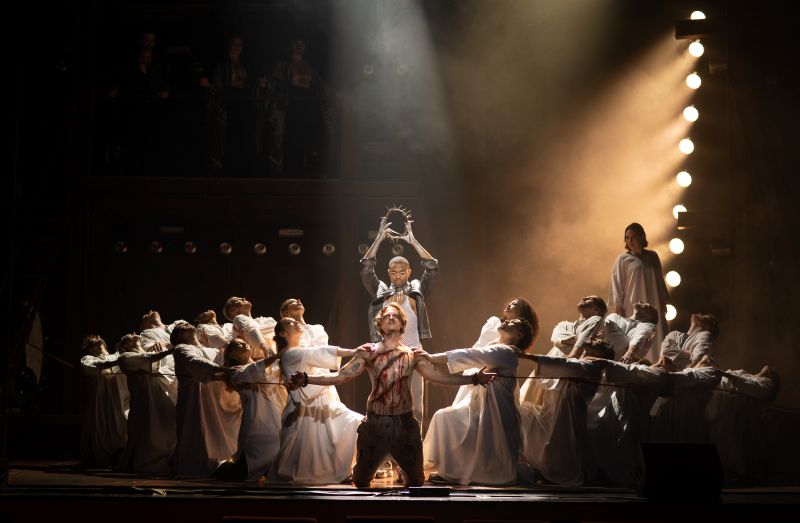
More than five decades ago, Tim Rice and Andrew Lloyd Webber reimagined the final days of Jesus Christ through a concept album. Today, Jesus Christ Superstar still feels far removed from a conventional religious drama. In the production by London’s Regent’s Park Open Air Theatre, directed by Timothy Sheader, an industrial-style set, a rock score and highly physical choreography place the story in a distinctly contemporary world.
Making its Singapore debut at the Sands Theatre, Marina Bay Sands, the international touring production stars Luke Street as Jesus and Javon King as Judas, with homegrown performers Tabitha Nauser and Frances Lee sharing the role of Mary Magdalene. You do not need to know the Biblical story in detail to be drawn into the production. From its opening number, it feels more like a rock concert charged with theatrical energy, gradually pulling the audience into the final week of Jesus’ life through its music, movement and characters.
The show does not begin by creating a sacred religious space. As the opening music starts, performers run towards the stage from the back of the auditorium, while the lights slowly come up. The industrial set, contemporary street-style costumes and energetic ensemble immediately make the production feel more like a rock concert than a recreation of ancient Jerusalem.
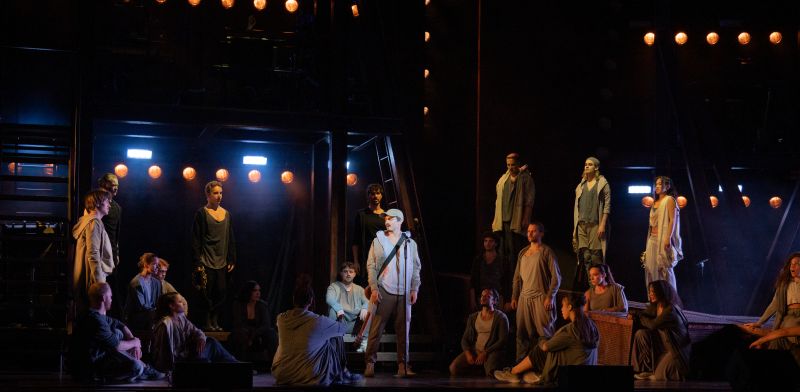
Jesus looks more like a rock musician stepping into the middle of a crowd.
So, which one is Jesus? It takes a moment to realise that the man in the baseball cap, carrying a guitar, is the central figure of the story. This Jesus looks nothing like the traditional image of a long-haired, white-robed saviour. He looks more like a rock musician stepping into the middle of a crowd.
It is a deliberate directorial choice. Jesus is introduced not as a distant religious figure, but as a rock star among his followers. Tom Scutt’s set design makes no attempt to recreate temples, palaces or Biblical landscapes. Instead, its industrial structures and street-inspired visual language, combined with Drew McOnie’s energetic choreography, create the atmosphere of a contemporary live concert.
The crowd is not simply there to fill the stage. They provide much of the energy on stage, while also becoming part of the process through which Jesus is transformed into a “Superstar”.
Javon King’s Judas is one of the most compelling performances of the evening.
He is not a gentle Judas. He is angry, restless and constantly questioning. From the opening number, “Heaven on Their Minds”, he makes his unease about Jesus’ growing popularity clear. He seems to recognise earlier than the others that the growing frenzy around Jesus could lead somewhere dangerous.
This makes him more complicated than the conventional image of the “traitor”. His concerns are not entirely misplaced. His problem is that he is perhaps too convinced that he knows what is best for Jesus. In trying to intervene in Jesus’ choices, he gradually crosses the line between concern and control.
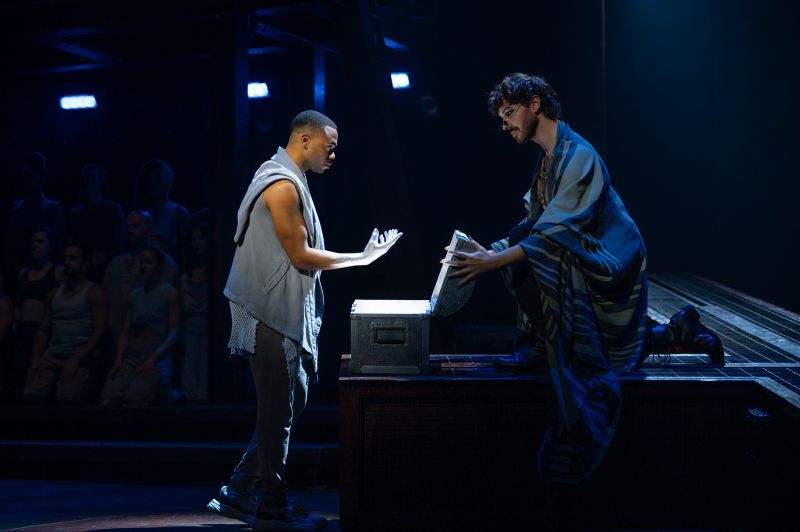
Javon King and Grant Hodges
That character arc reaches a striking visual moment at the end of the first act.
Judas reaches both hands into a box of silver coins and raises them. In the darkened space, the silver covering his hands catches the light and becomes almost blinding. Betrayal is no longer simply a plot development; it becomes a physical image that cannot be ignored.
Those silver-covered hands mark the turning point of the entire show. The lights go out, and the first act ends.
It is an effective choice to leave the audience there. Rather than ending on a conventional musical-theatre climax, the production stops at the moment Judas has crossed a point of no return. When the second act begins, it is the Last Supper. Jesus sings of the betrayal he knows is coming, while the audience already knows that Judas has no way back.
One of the production’s strengths is the clever way it uses a single set.
The same core structure is continually transformed by the action. A cross-shaped platform on the floor initially resembles a huge runway or the main stage of a rock concert. Later, it becomes the table for the Last Supper.
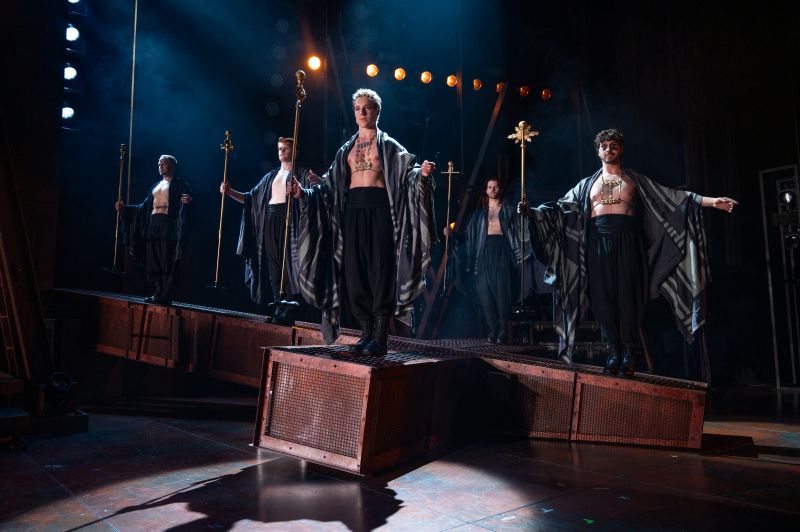
A cross-shaped platform on the floor takes on different meanings as the story progresses.
It is not simply an economical approach to set design. The space itself takes on different meanings as the story progresses. The cross becomes both a religious symbol and a performance platform; a gathering place for the crowd also becomes the space in which Jesus ultimately confronts his fate.
Tom Scutt’s design avoids trying to recreate Biblical Jerusalem, while Lee Curran’s lighting reinforces the contemporary concert aesthetic. During the solo numbers, the light often pulls an individual performer away from the crowd, turning the spotlight itself into part of the character’s emotional world.
The result is a production that may tell a story set 2,000 years ago, but speaks entirely in the visual language of contemporary theatre.
It was only in the second half that I began to empathise with Luke Street’s Jesus.
In the first act, Jesus is not particularly easy to warm to. He is followed and admired by the crowd, and seems increasingly accustomed to occupying the centre of attention. For an audience unfamiliar with the religious context, he can even appear contradictory and difficult to fully understand.
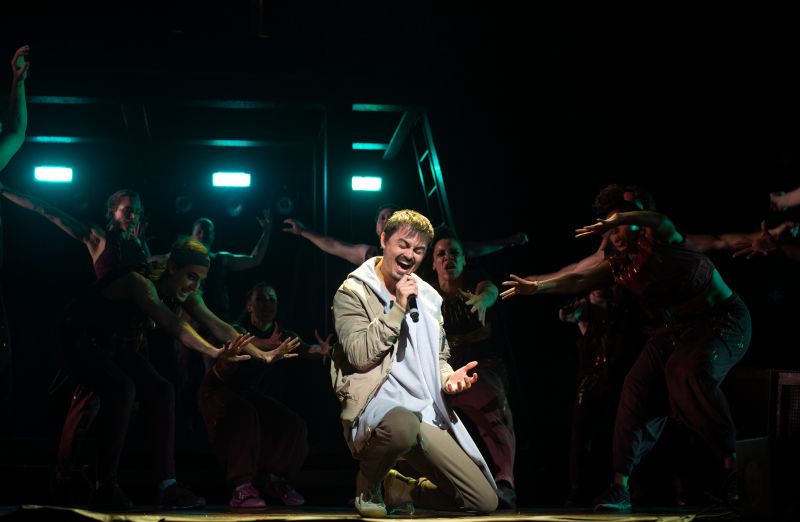
Luke Street in The Temple
Then comes “Gethsemane”. It is one of the most striking musical moments of the evening, and one that is considerably more powerful live than on a recording. Beams of light move across the high space as Jesus questions his fate. Towards the end of the song, he almost collapses to the floor, his voice breaking with fear.
For a moment, he is no longer a saviour. He is simply a man afraid of dying.
Until then, Jesus has remained constantly under the gaze of the crowd — followed, worshipped and expected to become a saviour. In “Gethsemane”, he finally steps out from behind that image and reveals his fear, hesitation and vulnerability.
I still cannot say that I particularly liked this Jesus. But in that moment, I finally felt for him.
And immediately after this, Judas comes forward and kisses him, pushing the story firmly into its final tragedy.
Singaporean performer Tabitha Nauser is another highlight of the production as Mary Magdalene.
Her voice is clear and distinctive, while her emotional delivery remains expressive without becoming overly sentimental. After the chaos of “What’s the Buzz”, her “Everything’s Alright” brings a moment of calm and tenderness to the stage.
Then comes “I Don’t Know How to Love Him”, one of the musical’s most enduring songs. Nauser does not treat it simply as a love song. Instead, she brings out Mary’s uncertainty and emotional confusion as she tries to understand what it means to care for a man who has been given increasingly impossible expectations by the crowd, religion and fate.
The song takes on an unexpected echo later, when a similar melody returns in Judas’ moment of regret.
Mary sings of tenderness and uncertainty; Judas sings of pain after the loss. The same melody takes on two very different emotional meanings, creating an unexpected parallel between the two characters.
If Mary does not know how to love Jesus, perhaps Judas only realises after losing him that he never really knew how to love him either.
As a musical built around a rock score, Jesus Christ Superstar naturally places music at the heart of the production.
What works particularly well live is the way the score does not remain at the same rock-concert intensity throughout. The ensemble numbers are energetic and physical, while the solo performances repeatedly change the scale of the stage, drawing the audience from the noise of the crowd into the inner worlds of the characters.
“Gethsemane” is the clearest example. A stage that has often felt like a rock concert suddenly takes on the quality of an aria, with Luke Street’s performance and the lighting taking Jesus to the emotional breaking point.
Another small but memorable surprise comes with “King Herod’s Song”. Herod appears only briefly, but the number is highly theatrical, with a deliberately exaggerated, mocking edge that makes the character hard to forget. It brings a sharp, almost satirical energy to an otherwise increasingly dark story.
By the end, what stays with me is not simply any one song, but the sheer energy of the production on stage. For all its Biblical subject matter, Jesus Christ Superstar feels much more like a rock concert than a conventional religious drama.
Jesus Christ Superstar began as a concept album before becoming a stage musical. Its appeal has endured because this production never treats Jesus as a distant, untouchable holy figure. Instead, it places him in the middle of the crowd, surrounded by music, movement and lights.
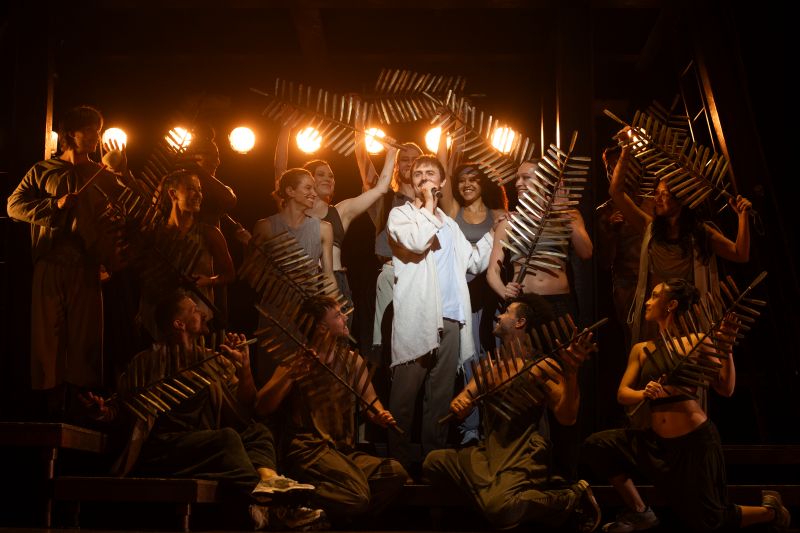
Jesus in the middle of the crowd
McOnie’s choreography is central to this transformation. The ensemble moves with the precision and intensity of a rock band, shifting almost effortlessly from disciples to fans to an increasingly frenzied crowd. Their movements do more than fill the stage; they give physical form to the changing mood around Jesus.
The crowd does not simply follow him. Through its energy, worship and growing frenzy, it also helps turn him into a Superstar. And as the story darkens, that same collective energy takes on a more threatening quality. What begins as adoration gradually becomes pressure, hostility and violence.
Judas is perhaps the first to sense where this could lead, yet ultimately becomes part of the tragedy himself.
So when the curtain falls, what stays in my mind is not simply Jesus, nor Judas, but the word that has carried this musical from the 1970s to today: Superstar.
That may be why the musical has endured. Although it tells a 2,000-year-old story about a saviour, it still leaves us with a question that feels surprisingly contemporary: What happens to the person behind the superstar?
Jesus Christ Superstar
Dates: 19 August – 6 September 2026
Venue: Sands Theatre, Marina Bay Sands, Singapore
Duration: 110 minutes, including a 20-minute interval
Tickets: From S$58, excluding booking fees. Dynamic pricing applies.
Booking: Marina Bay Sands Ticketing | SISTIC