
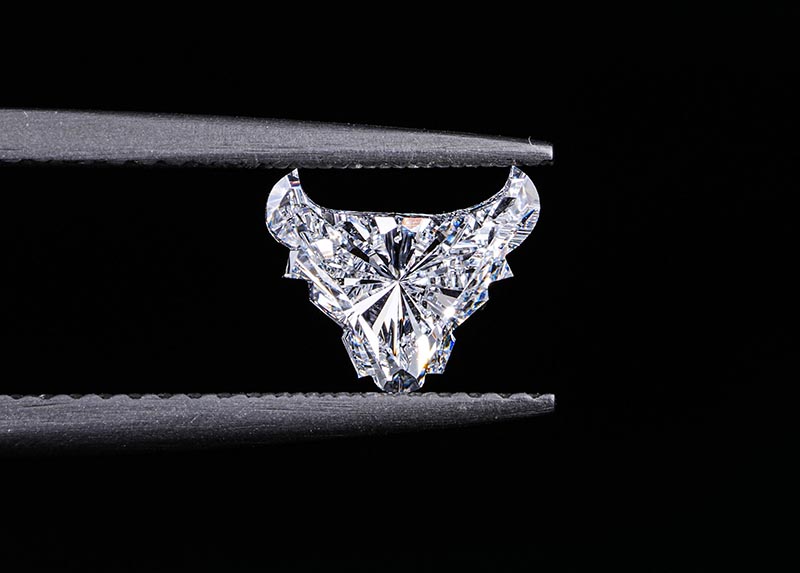
The word sparkle does too much work. We use it for the flash of white light off a facet, for the small rainbow that appears when you tilt a stone, and for the busy flickering as a hand moves across a table. Three different events, one word, and the result is that most people cannot say what they actually like about a diamond. They only know that some stones do it better than others.
The grading world separates them. GIA defines brightness as the total internal and external reflection of white light, fire as the dispersion of light into the colours of the spectrum, and scintillation as the pattern of light and dark areas and the sparkle when the stone moves. Cut-focused sellers offering diamond in Singapore name all three separately for the same reason. Once you split them apart, you can work out which one you are actually shopping for.
Brightness fire and scintillation
Brightness is the plain white return. It is what makes a stone look bright rather than grey, and it is the effect that survives almost any lighting condition. If you want a diamond that never looks dull, this is the one to care about.
Fire is the rainbow. Light entering the stone splits into its component colours on the way through, and you catch brief flares of orange, blue and green. Fire is dramatic, and it is conditional. It needs a small, strong source of light to split.
Scintillation is the movement. GIA describes it as the pattern of light and dark areas and the sparkle when the stone moves, which is a precise way of saying a diamond needs contrast in order to twinkle. A stone with no dark areas has nothing to flash against, which is why a perfectly uniform one can look oddly lifeless.
Excellent is a range
Now the part that should change how you shop. GIA is explicit that each grade range represents a range of proportion sets, so there is plenty of room for personal preference within a preferred grade range.
Read that slowly. Excellent is not a point. It is a band, and stones inside the band are not identical. Two diamonds can both be graded Excellent and lean in different directions, one towards brightness, one towards fire, and both are graded correctly.
So the certificate ends the conversation about quality and begins the one about preference. Asking whether a stone is Excellent gets you into the room. It does not choose the stone for you.
Match it to your lighting
Here is the most practical rule in this article. Fire is dispersion, and dispersion needs a point of light. Under a flat office ceiling there is no point, so what you mostly see is brightness. Under a chandelier, a spotlight, a candle or direct sun, you get fire and scintillation.
So think honestly about where the ring will spend its life. Not where you happen to be looking at it.
- Mostly diffuse indoor lighting, all day, most days
- Evenings out, under small warm point lights
- A lot of hand movement in conversation
- Quietly bright, or openly showy
Someone who spends long days under ceiling panels and rarely goes out is buying brightness. Someone who lives in restaurants and talks with their hands is buying scintillation. Both can buy an Excellent stone and be quietly disappointed by the wrong one.
The weight you cannot see
GIA includes something called weight ratio in its assessment, which it describes as a diamond’s overall weight in relation to its diameter. It is a quietly important idea.
Carat is weight, not size. A stone can carry extra weight down in its depth, below the girdle, where nobody will ever see it. You pay for that weight by the carat and you see none of it face up.
So compare diameters, not only carats. Two one-carat stones can differ noticeably in how large they look on a hand, and the difference is simply where the weight was put.
Cut also affects durability
This is the least romantic point here, and the one nobody raises. Among the design factors GIA assesses is durability, which it defines as the risk of damage inherent in a polished diamond’s proportions.
Diamond is extremely hard, which people tend to hear as unbreakable. Hardness resists scratching. It does not prevent chipping. A very thin girdle or a sharp unprotected point is a weak spot, and rings live rough lives on hands that open car doors and carry shopping.
So ask about girdle thickness, and ask whether the setting protects any vulnerable points. It is a five-second question that occasionally saves a repair bill years later.
So, the short version to carry into a showroom. Sparkle is three things, and you have a preference among them even if you have never named it. Excellent is a range wide enough for that preference to matter, so let the certificate qualify a stone and then choose with your eyes. And look at the diameter, not only the carat, because the part of a diamond anybody falls in love with is the part they can see.